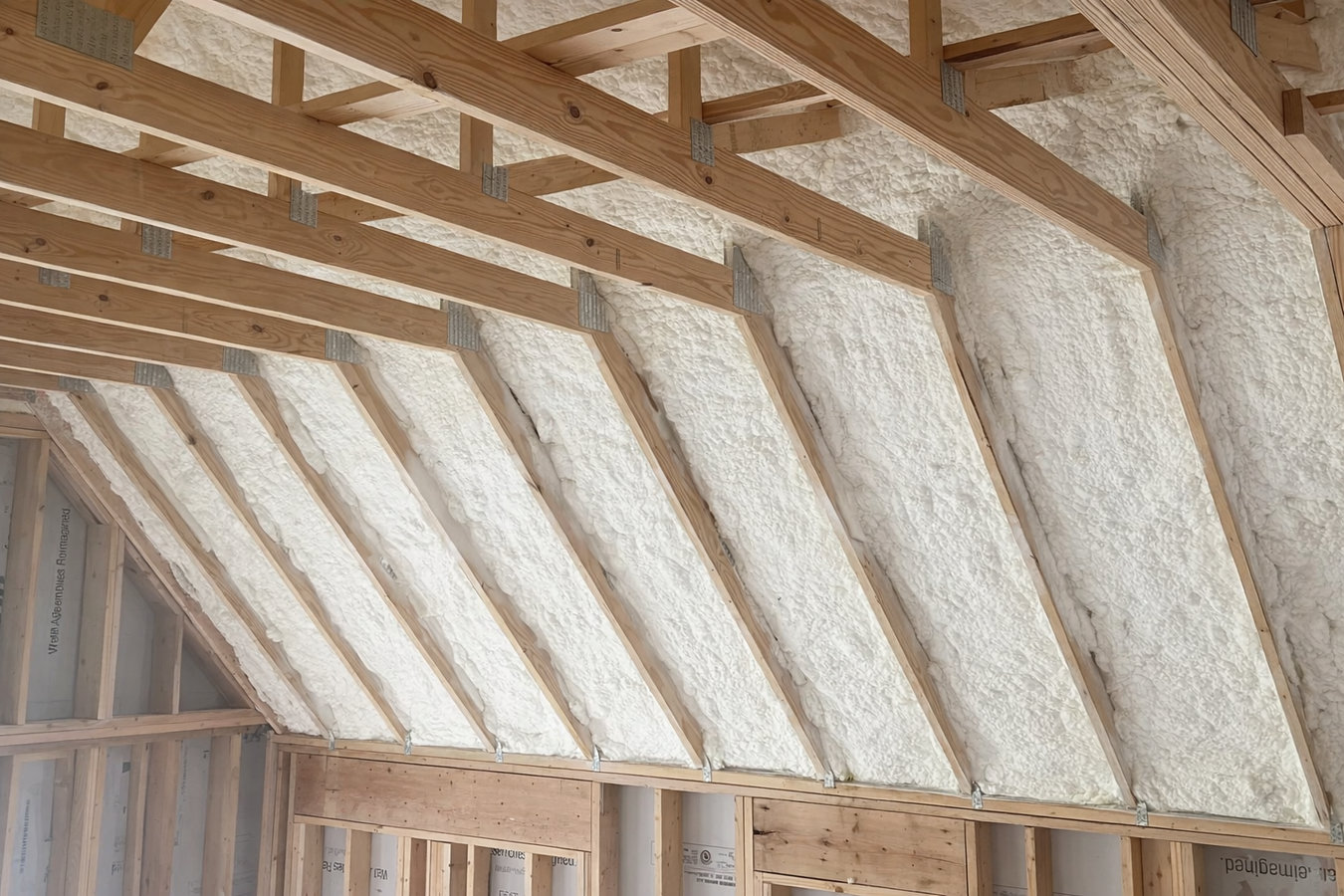
Goose Creek summers push heat and humidity through every gap in your home. Closed-cell foam handles both in one application - blocking air, blocking moisture, and keeping your living space comfortable year-round.
Closed-cell foam insulation in Goose Creek, SC is a two-part spray that expands on contact and cures into a hard, dense layer - it blocks both air and moisture at the same time, and most residential attic or crawl space jobs are finished in a single day.
Unlike fiberglass batts or blown-in insulation, closed-cell foam bonds directly to the surface it touches with no gaps or seams for air to move through. That matters a great deal in a climate where humidity finds every opening in your home's envelope. Most traditional insulation slows heat transfer but does nothing to stop moisture movement - closed-cell foam handles both in a single application, which is why it has become the go-to choice for crawl spaces and exterior walls in the Lowcountry. If you are also weighing the broader category of spray foam options, our spray foam insulation page covers how open-cell and closed-cell compare side by side.
Once cured, closed-cell foam is rigid and adds measurable stiffness to the surfaces it bonds to. In a region that sees tropical storms and occasional hurricane-force winds, that added structural strength to walls and roof decking is a real benefit - not just a sales point. The foam does not sag, settle, or compress over time the way older insulation materials can.
If your electricity bill climbs sharply from June through August and your HVAC system runs almost constantly, your home is likely losing the battle against Goose Creek's summer heat and humidity. This is one of the clearest signs that conditioned air is escaping and hot, humid outdoor air is getting in - exactly the problem closed-cell foam is designed to fix.
In homes with uninsulated crawl spaces - common throughout the Goose Creek area - the floor above often feels noticeably warmer or more humid than the rest of the house. If walking barefoot in summer feels like stepping on a warm, slightly damp surface, your crawl space is almost certainly allowing outside air and moisture to move freely into your living space.
A persistent musty odor, particularly in lower rooms or near the floor, often points to moisture accumulating in the building structure. In the Lowcountry's wet climate, this frequently starts in the crawl space or at the base of exterior walls. It does not always mean mold is present, but it does mean conditions are right for it to develop if nothing changes.
Older homes in Goose Creek neighborhoods like Crowfield Plantation, Liberty Hall, and Devon Forest were built under energy codes that allowed far less insulation than what is standard today. If you have never had an energy audit or insulation upgrade, there is a strong chance your attic and crawl space are significantly under-insulated - and you are paying for it every month.
We apply closed-cell foam to crawl space walls and rim joists, attic roof decking, exterior wall cavities, and band joist areas throughout Goose Creek and the surrounding Berkeley County area. For most Goose Creek homes built on crawl space foundations, rim joist and crawl space wall treatment is the highest-impact upgrade available - it cuts off the main pathway for ground moisture and outside air to enter your living space. For attics, applying foam directly to the roof deck creates an unvented attic assembly that holds temperature more consistently and keeps humidity from moving through the sheathing. The related open-cell foam insulation service is available for interior walls and attic cavities where moisture exposure is lower and budget is a priority.
Every job begins with an on-site assessment. We check current insulation conditions, look for signs of moisture or mold, and identify any prep work that needs to happen before foam is applied. Spraying over a moisture problem does not solve it - the sequence matters, and we get that right before any material is installed. We also document where foam is applied so any future tradesperson working in the same area knows what they are dealing with.
The highest-impact upgrade for Goose Creek homes on crawl space foundations - stops ground moisture and outside air at the source.
Creates an unvented attic assembly that holds temperature more consistently and blocks moisture from moving through the roof sheathing.
Best for new construction or major renovations where wall cavities are open and need a durable moisture and air barrier.
Targets the framing at the perimeter of your floor system - a common air leakage point in older Goose Creek homes.
Goose Creek sits in the South Carolina Lowcountry, where summer relative humidity regularly exceeds 80 to 90%. That moisture-laden air is constantly looking for ways into your home, and it finds every gap in the envelope - particularly in crawl spaces, attics, and exterior walls. Standard insulation slows heat transfer but does almost nothing to stop moisture movement. Closed-cell foam creates a genuine barrier against both, which is why it performs better in this climate than in drier parts of the country. Goose Creek also grew rapidly during the 1970s through 1990s, and many neighborhoods contain homes built with minimal air sealing by today's standards - meaning the potential savings from a foam upgrade are often larger here than in newer construction. Homeowners in North Charleston and Ladson share the same climate conditions and see the same results from closed-cell foam upgrades.
Goose Creek is also roughly 20 miles from the Atlantic coast and sits in a region that sees tropical storms and occasional hurricane-force winds. Closed-cell foam applied to roof decking from the inside can help the roof structure resist wind uplift better than a ventilated attic with loose insulation - this is increasingly common in new construction in the Charleston metro area and is worth discussing when your roof deck is accessible. The EPA guidance on spray polyurethane foam covers re-entry timelines and safety practices if you want to understand the process before calling.
We respond within 1 business day. We will ask a few questions - the age of your home, which areas you want insulated, and whether you have noticed specific comfort or moisture problems. Be cautious of any company that quotes a price over the phone without seeing the job.
We walk through your attic, crawl space, or the specific area you want treated. We check existing conditions, moisture levels, and accessibility. This visit typically takes 30 to 60 minutes, and a written estimate follows within a day.
Everyone in the household - including pets - needs to be out of the home during the job and for a set period afterward. Your contractor will give you a specific re-entry time in writing. Most contractors ask for at least two to four hours after spraying is complete.
A typical attic or crawl space job takes two to four hours of actual spraying. Before the crew leaves, walk through the finished work with them - even coverage with no bare spots is the standard you should expect. We document where foam was applied for your records.
Free in-person estimate. Written quote. No obligation - we explain what we recommend and why before any work begins.
(843) 931-2094Most homes in Goose Creek are built on crawl space foundations, and those spaces present moisture challenges that contractors from drier climates are not prepared for. We do this work in this climate every day and know which approaches hold up in Berkeley County's conditions.
Spraying foam over a moisture problem or skipping prep work does not fix anything - it traps the issue inside. We assess the space first, address any moisture concerns, and apply foam in the right sequence so the work actually performs the way it should.
Every homeowner gets a specific re-entry time in writing before the crew starts work. You will not be left guessing when it is safe to come back. This is a basic professional standard, and we hold to it on every job.
We confirm with Berkeley County whether a permit is needed for your specific project and handle pulling it ourselves. Permitted work is inspected by an independent county inspector, which protects your investment and makes future transactions on the home straightforward.
Closed-cell foam is one of the most durable insulation materials available, and when it is installed correctly in the right locations, it pays for itself over time through lower energy costs and fewer moisture-related repairs. The Spray Polyurethane Foam Alliance sets training and certification standards for installers - ask your contractor whether their crew has completed SPFA training before any work begins.
A lower-density foam option for interior walls and attic cavities where budget matters and moisture exposure is lower.
Learn MoreA full overview of both closed-cell and open-cell spray foam applications for attics, walls, and crawl spaces in Goose Creek.
Learn MoreGoose Creek summers are long and expensive to cool - locking in your installation date now means a more comfortable home from the first hot week of the season.